Save water, save time, cook your pasta in your frying pan!
Brilliant!
Take care!

Showing posts with label Being green. Show all posts
Showing posts with label Being green. Show all posts
Sunday, November 6, 2011


Thursday, May 19, 2011
Thursday, January 13, 2011
Catalytic Clothing - to help us breathe more beautifully
Ok, this is the second day I post a link to an article I have written for another venue, I'm sorry. I do have something planned just for you for tomorrow.
In the mean time, head over to Love Garden Design to catch a glimpse of the future; clothing that can purify the air.

Love Garden Design: Catalytic Clothing - to help us breathe more beaut...: "Would you believe me if I told you your clothes may one day play a part in a global effort for carbon sequestration? "
Take Care!
Source & Picture Credit:
Chua, Jasmin M. "Meet "Herself", the World's First Air-Purifying Dress". Ecouterre.Jan 7th, 2011 [Online]Jan 13th 2011. http://www.ecouterre.com/meet-herself-the-worlds-first-air-purifying-dress/
In the mean time, head over to Love Garden Design to catch a glimpse of the future; clothing that can purify the air.

Love Garden Design: Catalytic Clothing - to help us breathe more beaut...: "Would you believe me if I told you your clothes may one day play a part in a global effort for carbon sequestration? "
Take Care!
Source & Picture Credit:
Chua, Jasmin M. "Meet "Herself", the World's First Air-Purifying Dress". Ecouterre.Jan 7th, 2011 [Online]Jan 13th 2011. http://www.ecouterre.com/meet-herself-the-worlds-first-air-purifying-dress/
Friday, January 7, 2011
Plarn Purses - Using Plastic Bags as Yarn
Interview with a fascinating lady with a fabulous green craft.
I met Pat at the One of a Kind Show last November. She was perusing the aisles carrying a bag with a story. Keep reading to find out about up-cycling, plastic bags, plastic soup, plarn, Pat's recipe for greener living and some pretty darn good looking Plarn Purses.

How did you get into up-cycling?
Well, necessity is the mother of invention, My grandma who was a single mother who had to raise her children during the great depression taught me be thrifty and to use any resources I could.I watched (and helped) her cut up old clothing to make patchwork quilts.She said that wasting usable things is sinful. I can remember how she would take old greeting cards and cut them up to make gift tags for presents, She even let me use her pinking shears to make them look prettier.
She also taught me how to knit and crochet. She was real good at it, She made those colorful fancy doilies. My mom still has some of them in her tables.
For Christmas one year I got one of those looms to make pot holders, Grandma suggested I use loops from cutting up old shirt sleeves to weave into pot holders.
So for years everyone got woven pot holders as gifts from me.
My older cousin lived on a farm. She would unravel the string that is sewn across the feed and flour bags, tie them together and crochet them into dish towels.I thought that was a great idea . henceforth, a monster was born. I kept an eye out for anything that could be used as thread to be either knitted or crocheted.
Years later I also found myself a single mother. So I had to become creative and make do, I can remember cutting up old jeans, to make covers for my daughters diapers. No pampers here , She wore cloth diapers, rubber pants, with fancy embroidered denim covers, She was called a baby hippie. I still have the denim skirt that I made for myself. I opened the leg seams up and put in a patchwork panel and had myself a "maxi" skirt.
Why Plastic Bags?
Not to give away my age but I can remember the line in Dustin Hoffman's, The Graduate, where his uncle put his finger in the air and said "Plastics" I was wondering what's up with Plastic? Little did I know that it could become such a hazard to the planet.
The grocery stores started to use plastic bags. They held up so much better than the paper ones especially where I live and have to haul groceries in the snow. I live at 9,352 feet above seal level in the Rocky Mountains. We see a lot of snow! Plastic held up so much better. I always found other uses for the bags. We even used them on our feet under our boots to keep our feet dry in the snow.There were always plenty of reuse for those bags.
The idea hit, loop them together to make a carryall bag that will hold up with heavy use. I toyed with lots of different styles ( and still am). The handle has to be sturdy with not too much stretching.

How do people react to your work?
When people first see my purses they don't realize that they are made from recycled plastic bags. They don't look like plastic bags after they are cut, spun onto "plarn" then knitted or crocheted into sturdy carryalls and sometimes elegant purses. So far everyone who has seen them are delighted and have to hear all about the Pacific Garbage patch and the poor marine life.

Where do you get your materials?
After I used up my personal stash of plastic bags, I put ads on Craigslist asking for people's colorful bags that the newspaper comes in. Sometimes I find a "bag of bags" on my car seat or front door. Needless to say I have an unlimited supply of free plastic bags.

How did you first hear about the "Plastic Soup", the floating waste of the Pacific Ocean?
One Earth day I was watching Oprah. She had people on talking about the "great Pacific Swirl" I researched and found out more about the "plastic soup"in the ocean. I was disgusted with what I was seeing and hearing, Oh!, those poor marine animals. They don't know what plastic is and think it is food, eat it then have it bind up their guts so they die a painful death. Once they die they fall to the bottom of the sea another fish will come along, eat the dead animal, get their guts bound up with the same piece of plastic and also die. How many sea animals can be killed by the same piece of plastic?
Why should people be concerned?
I read research that was done by Greenpeace about this problem. They say that 20 billion tons of trash in dumped into the oceans each year.There is no safe place to dump plastic. This problem is threatening the food chain because a large amount of the of the food we eat comes from the sea. Another frightening fact is that the oceans produce 70% oxygen on this planet... need I say more?
What steps have you taken to reduce your contribution to the "Plastic Soup"?
I always tried to keep my carbon footprint small as possible. Almost every thing I own was bought on the used market and very little of it is made of plastic.
What green steps do you suggest to people that are concerned about waste?
People need to become conscious of this problem and think twice before buying disposable products. As well as buying in bulk where you could provide your own container to avoid having to throw away packaging. There are many ways each person can be conscious of their carbon footprint, their own health as well as the health of this beautiful planet.
You can read more about the Pacific Swirl by visiting Pat's website www.rockymttreasures.com. Be sure to stay tuned because new designs will be posted soon.
This concludes our Plastic Week on Purple Carrots and Fairy Smoke I hope you had a great week. Have a wonderful weekend, see you on Monday!
Wednesday, January 5, 2011
Turning Plastic Back into Oil
I don't know about you, but I generally get pictures of wide-eyed puppies and dancing elves as FWD messages in my Inbox. My mother, however, seems to have very enlightened friends because once again, today's post is possible courtesy of Mum's Inbox.
The video I have re-posted today is about an exceptional japanese machine, a machine that turns plastic trash back into oil. The Man behind this invention is Akinori Ito, Ceo of Blest. His love of nature and the realization of the present state of the world motivated the invention of conversion technology. The video explains very little of the process but Blest assured Our World 2.0 that if the proper materials were fed into the machine no toxic residues would be produced and that the machine is equipped an off-gas filter to transformed methane, ethane, propane and butane into water and carbon.
Our World 2.0 quoted Ito saying: "To make a machine that anyone can use is my dream[.] The home is the oil field of the future.” With our garbage bags bulging with plastic packaging and the threat of disappearing oil, our trash may well be the oil of the future.
For the time being the conversion machine is not available to the public but it has been implemented in farms, fisheries and small factories all over Japan and is slowly expanding to other countries.
Watch the video, read the article by Carol Smith and come back and let me know what you think.
Is this the miracle solution we have been waiting for?
Or another excuse for consumerism?
Or maybe it's a small step towards a more conscious future.
Take care!
___________________________________________________________
Sources:
The video I have re-posted today is about an exceptional japanese machine, a machine that turns plastic trash back into oil. The Man behind this invention is Akinori Ito, Ceo of Blest. His love of nature and the realization of the present state of the world motivated the invention of conversion technology. The video explains very little of the process but Blest assured Our World 2.0 that if the proper materials were fed into the machine no toxic residues would be produced and that the machine is equipped an off-gas filter to transformed methane, ethane, propane and butane into water and carbon.
Our World 2.0 quoted Ito saying: "To make a machine that anyone can use is my dream[.] The home is the oil field of the future.” With our garbage bags bulging with plastic packaging and the threat of disappearing oil, our trash may well be the oil of the future.
For the time being the conversion machine is not available to the public but it has been implemented in farms, fisheries and small factories all over Japan and is slowly expanding to other countries.
Watch the video, read the article by Carol Smith and come back and let me know what you think.
Is this the miracle solution we have been waiting for?
Or another excuse for consumerism?
Or maybe it's a small step towards a more conscious future.
Take care!
___________________________________________________________
Sources:
Smith, Carol. "Plastic to oil fantastic." Our World 2.0 27 Aug. 2010. Oil. 03 Jan. 2010 .
Monday, January 3, 2011
The Ubiquitous Plastic Bag

Consider this:
1- the average usage is of 20 minutes,
2- they will remain in our landfills or floating around our cities for over 100 years,
3- if they do not end-up in landfills, they litter our oceans where they are a frequent cause of death for endangered marine life.
With this in mind, it may be a very good idea to find a way to reduce our consumption and find something to do with these bags.
Reducing the number of bags we use per year is quite an easy problem to solve: bring your own bags or leave without a bag. Most of the time the items we buy don’t actually need to be put in a bag; like chocolate bars, packs of gum, or even a bottle of water. Don’t blame the cashiers, they have been brainwashed into a highly efficient monotonous routine of greeting, offering another product or service, rapidly putting items in a bag, and wishing the customer a nice day. They don’t even realize they’re doing it. That’s where you come in. Before getting to the cash, put down your cell phone, put on your nicest smile, rapidly respond to the greeting and add “I won’t be needing a bag, thank you!” This might not register the first time so patiently repeat and if necessary, remove the items from the bag. They may find you annoying and perhaps a little tree hugging weird but keep it up, being slightly marginal for the right causes is worth it. A wise woman once told me that showing the example is not just a good way of effectively influencing others, but the only way. The most common argument for continuing to rely on grocery bags is the promise of a second use: for when you walk the dog, to put in your garbage bins, etc.. We all know plastic bags have a way of coming to you even when you are trying your best to avoid them.
Let's be realistic here, occasions will arise when will have no other choice but to accept plastic bags. Most recycling centers accept plastic bags if they are all gathered up and not left to drift around your blue bin, however, recent information points to differing policies depending on the recycling center. These plastic bags will be melted down and hopefully be used to form new bags or other plastic objects, but their fate is uncertain. Interestingly, most plastic grocery bags are already made from recycled material, that’s one thing they’ve got going for them.Side note to Dog Owners: Picking up your precious darlings excrement is most probably your least favorite part of the dog owning experience and although just leaving it there for the elements to wash always may seem to be the "greener" option, it not (especially in a city environment). There is a great option called BioBag. Whole Dog Journal gave these bags a 4 out 4 paw rating because this product passed the ASTM 6400 testing for compostable bags. You can purchase online without shipping fees at dirtworks.net.
In Nigeria, they have come up with an interesting idea to put to good use the large quantity of plastic bags that find their way into their city in spite of the recent ban and newly implemented fines; they melt them down to form super resistant cobblestones. The method is quite simple. First you melt down polyethylene bags (those that do not liberate toxic products) in an oven, then you add sand (an abundant resource in this arid region). After 30 minutes, you pour the resulting mixture into a mold and in less than 45 minutes, you have ready-to-use cobblestones. This project was started by Paolo Giglio, a Nigerian artisan, whose aim was to reduce the quantity of bags littering his home town and give jobs to the local people, however, even though the ministry has approved his products, no contracts have been received and the plastic stones are just piling up (2004).
Plastic bags are practical, easy to dispose of and available; their presence in the future is undeniable. Never the less, a little effort and innovation on our part will reduce their impact on the aesthetics of our cities and the survival of bag eating wildlife like whales and turtles.
How do you avoid hoarding plastic bags home?
Coming up: Japanese ingenuity to the rescue.
Take care!
Thursday, December 23, 2010
{Being Green} Reusable Mugs
 TWENTY THREE BILLION cups is the estimated annual consumption of paper cups for the U.S. alone in 2010 [1]. In 2006, Starbucks reported using 2.3 Billion cups[2], 82% more than in 2000 [3]. Now don't you think that's a little excessive? Abolishing coffee is absolutely out of the question, the only thing to do is stop using paper cups.
 The Concept: Pledge to always bring a mug or go without (or sit and sip).
What you need: 1 Reusable Mug, a good memory and a will of steal.
How to: The hardest part of this scheme is to find the perfect mug to fit your needs. I've put together a summary of my experiences with paper cup alternatives for your enjoyment.
Option 1 - If you are mostly in your office and have only a few steps between the coffee machine and your desk, the simplest and cheapest option is to bring a mug from home.


Option 2 - The Student option - I chose this option for sometime during college, it was convenient, multipurpose and fit in the side pocket of my backpack : the Mason Jar. Being in glass meant not only could I use it for coffee and tea but it could also substitute for a soup bowl, a water bottle, a snack holder, and much more. It was great! The leak proof screw on lid made it possible for me to throw it into my backpack and run without fear of covering my term papers or overpriced school books with coffee. The only problem is not being able to drink on the go. Do not attempt to drink in the bus, believe me, its more trouble and mess than it's worth.


Option 3 - I'm Not a Paper Mug - I must admit I am partial to the look of this option, not to mention being able to drink out of ceramic instead of plastic or stainless steel makes it very appealing. It comes in various colorus (depending on the company) and are under $20. However, these mugs equipped with a silicone top are a leak waiting to happen. It's best kept for someone who can wash and dry it before putting it back in a bag. Oh and not for butterfingers.

Option 4 - Travel Mug - The most diverse option. They come in all shapes, sizes, colours and price range. The most important thing to consider is the lid; it will make the difference between spill and no spill. The lids in the following picture have a high risk of leaking if not in a perfectly upright position. They are also the most common lids and generally associated with the cheapest cups.

 | ||
| The Rubber Stopper |
The first kind regroups all mugs that have a plastic flap with a fitted rubber stopper. If you remember to close it you won't have any problems.
 |
| The Twist |
The second kind, which I have only encountered at Starbucks have a twist top which opens in the middle. The concept is comparable to that of a thermos lid. It is harder to clean that the Rubber Stopper and can sometimes be hard to open. I used the Starbucks recycled tumbler for 3 years before it cracked and I had to purchase another.
 |
| Auto-seal |
The last option is a recent addition to my inventory - the Auto-seal mugs brought to you by Contigo (sold at select Starbucks and online). As opposed to the other mugs, you must press the button to drink; releasing causes the opening to automatically shut avoiding all possible spills.
I have presented you with various options solely based on size and lid style. I am still researching which material is the best. For now, choose a plastic that is BPA free, avoid heating up your coffee in your plastic mug and carefully prewash all reusable mugs. I strongly recommend drinking out of a stable material such as glass or pottery to avoid any possible transfers.
If you are interested in reading more discussions on the perfect mug, you may want to read the following:
Kitchen Scoop by Alicia Ross: She asks her readers to share their experiences and what their favorite mug is.
Jolly Mom who reviews the Contigo Auto-seal mugs.
Sustainability is Sexy gives you the facts about paper cups and mugs.
Ultimately the choice is up to you, hopefully it will help you find the ultimate reusable mug.
Take care!

[Edit: I am sorry for those that were expecting this post Monday and then Wednesday. I put the wrong year when I entered the date on the Scheduler. I'm already in 2011 baby! Sorry for keeping you waiting. - Emilie]
_________________________________________________________________
Sources:
Picture credits - all pictures are linked to their original site.
[1] Tully’s Coffee. Press Release. September 16th, 2007. http://www.tullys.com/company/press_release.aspx?id=40
[2] Environmental Defense. Starbucks Paper Project Goals and Results. July 20th, 2007. http://www.environmentaldefense.org/page.cfm?tagID=2155
[3] Starbucks Corporate Social Responsibility Report. Fiscal Year 2006. http://www.starbucks.com/aboutus/csrannualreport.asp
[4] Sustainability is Sexy. August 2009. [Online] Visited on Dec. 20th, 2010. http://sustainabilityissexy.com/facts.html
Friday, December 17, 2010
Greening the Advent Calendar

I can't recall when my Mum first introduced me to the concept, but I have loved it ever since. Even now, when I live in New York with my husband, she sent me a wonderful Cadbury Chocolate Advent Calendar. What a treat!
But in the optic of reducing waste produced by the holidays, a reusable advent calendar would probably be a better choice for the future.
While walking around Target, I found these adorable wooden Advent Calendars. They cost just under $30 and will last you a life time. However, you need to buy little treats each year. Which means you get better quality treats and they don't all have to be food.

The main issue I have with them is that the numbers are in order, I enjoy the challenge of finding the little numbers.These are the only options out there. If you have a minute, or if you need a minute, Google "Advent Calendars", there are some wonderful things being made.
What's your advent calendar look like this year?
Take care!
Monday, December 13, 2010
{Being Green} Starbucks
A recent article published on Environmental Leader, Energy & Environmental News for Business brought me great joy. Coffee drinkers everywhere, rejoice! Drinking coffee is on its way to becoming less damaging to the environment.

With two recycling pilot projects underway, Starbucks Coffee Company is well on their way to attaining their goal. Their first pilot test proved that their paper cups can be recycled into new cups. This project has stirred much excitement as the positive results could be used to change to future of the entire food industry as quoted from the vice president of International Paper Foodservice, Greg Wanta, since it increase recycling rates across the country.
Currently, Starbucks is testing its recycling program in 86 of its Manhattan stores and will be setting up a similar program in Chicago at the beginning of next year. Past successful projects include store-front recycling bins in Toronto and Seattle and composting in San Francisco. Statistics published in June 2010
Although shareholders voted down a motion to increase recycling at this year's annual meeting, 11% were in favor and we can only hope that more shall join in the movement to get this huge multinational onto the green bandwagon. For the time being, our best course of action is to encourage local stores to promote reusable mugs and green standards.
 Remember to as for your $0.10 discount when you bring your own mug (in the U.S and Canada). I speak from experience, most cashiers seem not only to be completely unfamiliar to the concept of Bring-your-own-mug but also unaware of the discount, BUT it's there, online, sepia on grey - demand it.
Also, if you are are planning to sit and sip your coffee, ask for a ceramic mug. They don't have any, they should.
Interested to learn more, visit Starbucks online. They have informative videos and stats. Here's the link:
Recycling & Reducing Waste| Starbucks Coffee Company
Coming next week : How to choose the best reusable mug.
Take care!
____________________________________________
References :
Starbucks is working on having 100 percent of its cups being reusable or recyclable and offer front-of-store recycling in all of its locations by 2015.
With two recycling pilot projects underway, Starbucks Coffee Company is well on their way to attaining their goal. Their first pilot test proved that their paper cups can be recycled into new cups. This project has stirred much excitement as the positive results could be used to change to future of the entire food industry as quoted from the vice president of International Paper Foodservice, Greg Wanta, since it increase recycling rates across the country.
Currently, Starbucks is testing its recycling program in 86 of its Manhattan stores and will be setting up a similar program in Chicago at the beginning of next year. Past successful projects include store-front recycling bins in Toronto and Seattle and composting in San Francisco. Statistics published in June 2010
Although shareholders voted down a motion to increase recycling at this year's annual meeting, 11% were in favor and we can only hope that more shall join in the movement to get this huge multinational onto the green bandwagon. For the time being, our best course of action is to encourage local stores to promote reusable mugs and green standards.
Remember to as for your $0.10 discount when you bring your own mug (in the U.S and Canada). I speak from experience, most cashiers seem not only to be completely unfamiliar to the concept of Bring-your-own-mug but also unaware of the discount, BUT it's there, online, sepia on grey - demand it. Also, if you are are planning to sit and sip your coffee, ask for a ceramic mug. They don't have any, they should.
Interested to learn more, visit Starbucks online. They have informative videos and stats. Here's the link:
Recycling & Reducing Waste| Starbucks Coffee Company
Coming next week : How to choose the best reusable mug.
Take care!
____________________________________________
References :
"Starbucks Turns Used Cups into New Cups." Environmental Leader. 20 Nov. 2010. [On line] 12 Dec. 2010 .
"Starbucks Recycling Cups at Chicago, Seattle Stores." Environmental Leader. 29 June 2010. .[On line] 12 Dec. 2010 .
Monday, October 18, 2010
{Being Green} Reusing Plastic Bottles
Good Morning and welcome to Monday,
 Let's start this week off right with a new Green Scheme. This week's concept comes to you courtesy of my Inbox and my Mother who lovingly sent me this viral email.
Although I don't often have plastic bottles available (I try not to buy them), I liked the idea and thought I should share it through another medium. It could come in handy for my peas and beans I buy per pound from the Health Food Store and who knows what creative ways a fresh Monday Morning Brain can come up with. Right? Okay.
The Concept: Use the top of a bottle to seal the common plastic bag.
What you need: A plastic bottle, scissors, a plastic bag (sandwich bag or bulk produce bag)
How to: 1. Empty and clean the plastic bottle. With the scissors, carefully cut off the top of the bottle leaving about an inch of the neck bellow the cap.

2. Remove the cap. Insert the bag through the top of the bottle (from the bottom) and screw the top back into place. You now have a bag that is air-tight and easier to pour once you master the technique of holding the bottle.

If you decide to take this idea for a whorl, let me know how well it worked and what you used it for. I'm curious.
Take care!
____________________________________________
Credits
Thanks Mum!
[Picture credits] : Source Unknown, (they came with the email)
Although I don't often have plastic bottles available (I try not to buy them), I liked the idea and thought I should share it through another medium. It could come in handy for my peas and beans I buy per pound from the Health Food Store and who knows what creative ways a fresh Monday Morning Brain can come up with. Right? Okay.
The Concept: Use the top of a bottle to seal the common plastic bag.
What you need: A plastic bottle, scissors, a plastic bag (sandwich bag or bulk produce bag)
How to: 1. Empty and clean the plastic bottle. With the scissors, carefully cut off the top of the bottle leaving about an inch of the neck bellow the cap.

2. Remove the cap. Insert the bag through the top of the bottle (from the bottom) and screw the top back into place. You now have a bag that is air-tight and easier to pour once you master the technique of holding the bottle.

If you decide to take this idea for a whorl, let me know how well it worked and what you used it for. I'm curious.
Take care!
____________________________________________
Credits
Thanks Mum!
[Picture credits] : Source Unknown, (they came with the email)
Thursday, October 7, 2010
{Being Green} Don't be a water waster
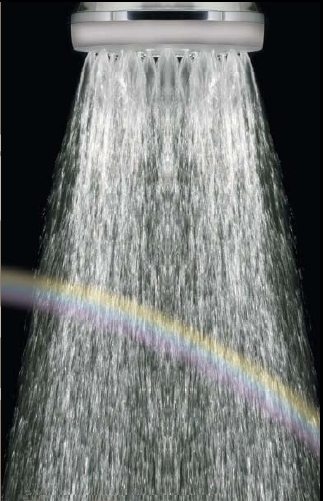 Water is now thought to be the most probable cause of another world war because of the exponential growth of the human population, the already small proportion of available drinking water and the increasing contamination of these sources.
Environmental campaigns always target our water consumption, National Geographic even produced a dramatic special issue called: Water, Our thirsty World. I wrote about it in a past post (click here). We all know about turning the water off when we brush our teeth, using low flow shower heads, toilets and what not. We are told but sometimes its hard to apply.
When it came down to showers, kicking the habit of long hot showers was much harder. I just love getting lost in a daze as the hot water gently washes over my body. But a 30min shower definitely puts me in the water waster category. I needed a method that would allow me to time my shower without the depressing thought of setting an alarm.
This is what I came up with:
The Concept: Use your favorite songs to time your shower.On average, commercial songs generally run for about 4min. Showering along to two of your favorite songs will not only improve your mood but also keep your shower to under 10min; significantly reducing your water consumption.
What you need: Some music playing device that won't electrocute you in the process.
How to: Step 1. Install some kind of musical device in or near your bathroom. There are shower radios available out there but I use this old boom box that I've strategically placed on my window sill to avoid contact with water (yes, I know, the rain but that is an entirely different issue).
Step 2. Get ready for your shower. Start the musical count down as soon as you start the shower running. Sing along and lather up. My objective is to be out the shower and drying off by the time the second song comes to an end. Voila! You are now taking less than 10min to shower and you have some great soundtrack for your day or night - depending on your showering preference.
Give it a try and tell me what you think.
Do you have any other water reducing habits?
Take care!
________________________
[Picture credit www.the-bathroom-designer.co.uk]
Tuesday, September 7, 2010
{Being Green} The Fabric Gift Wrap
 The Fabric Gift Wrap
{image via Chewing the Cud}
After reusing wrapping paper, newspapers, brown paper bags and colourful magazine adds, I adopted the fabric gift wrap in 2009 and have been applying the concept ever since. I figured I should do my part in spreading this trend when it popped up in this month's issue of RealSimple (I absolutely LOVE this magazine).
The Concept: Use fabric to wrap presents - no more pricey gift bags and non-recyclable shiny wrapping paper. Easy peasy!
What you need: A square piece of fabric large enough for your gift.
A bit of history: This trend may very well come to us via Japan where fabric wraps are a cultural staple; they are called furoshiki (meaning "bath spread"). The word comes from historical use of transporting clothes while at the public bath houses but the concept dates back long before the Edo period (1603-1868) when fabric wraps were called hirazutsumi meaning "flat folding bundle". The term furoshiki now extends to all fabric wrappings. Applying the principals of origami to fabric, you obtain the perfect wrap to transport gifts, lunch boxes, grocery shopping or even home decor.
Here is a great Youtube video showing multiple ways to wrap with fabric.
Your Options: 1- Chewing the Cud
RealSimple introduced this wonderful new online brand/company which produces many eco-conscious products such as their stunning selection of organic cotton fabric wraps which are on sale for 12$ (click here).
Great for a wedding or a very special gift, but with the number of gifts I wrap from Christmas and during the August-September birthday rush, this is not an economical viable option. (I am however saving up for the I Weelie Like You fabric wrap - I'm in love!)
2- Thrift store/Garage sale scarves
Going with the reduce and reuse strategy, hitting up your local thrift store, or even
 your Grandma's closet, you can find jewels for a fraction of the price. This summer during the Repentigny's (my home town) garage sale weekend, I bought 10 gorgeous satin scarves from the nicest old lady for 50 cents each! What a bargain!
Which ever option you choose, fabric wrapping is the way to go to reduce the amount of wrapping that ends up in the landfill.
If you are web savvy enough to be reading this, then you can certainly check out more creative ways of tying your fabric wrapped parcels readily available through Google Images and Youtube. I particularly enjoyed this jem - a gift wrapped in a shirt and embellished with a brooch. {Image via Countryliving}
The only thing left to discuss, is whether or not it's okay to ask for the fabric wrapping back. Is the wrapping part of the gift or not?
What do you think?
Take Care!
______________________________________________
References:
"9 Problem-Solvers of the Month." RealSimple. September 2010: 60
"Furoshiki". Wikipedia. Aug.22.2010. {Online} http://en.wikipedia.org/wiki/Furoshiki
Wednesday, April 28, 2010
For the Planet : Reusable Dryer Sheets

Natura Static-Free Reusable Dryer Sheets - Chemical Free

I recently discovered this wonderful product. Although I am still in the trial stages, I think it's great. It's a simple way to reduce trash and spending. Static Eliminator Reusable Dryer Sheets, as seen on amazon.com, come in packs of 2 for 15$. They are hypoallergenic, reduce cling, soften fabrics, and last for hundreds of loads.
Let's say you do 2 loads of laundry a week. Over a year, that comes up to 104 loads a year. You will use the same amount of dryer sheets if not more depending on whether or not you believe in double sheeting big loads and/or use them for other purposes. I can't remember how much dryer sheets cost right now but online the cheapest I found (on the one site I looked at by sheer laziness) they were $6.80 for 80 sheets (which seems a bit expensive but anyway). Taking these numbers, you will spend at least $9 a year on dryer sheets which you throw away after one use. Not to mention these sheets are accused by many to coat your clothes with chemicals and to be dangerous to children and pets. So why not spend 15$ (7.50$/year), reduce your trash and the amount of potentially dangerous chemicals in your house.
You can visit their website by clicking here. This company is endorsed by David Suzuki as they blatantly announce on their website (then again, so would I if it were the case).
Do you use this product? What do you think?
Would you consider using this product?
Take care!

Tuesday, April 6, 2010
Start your seedlings
Post-Easter greetings to all, I hope you had a wonderful weekend.
The weather was absolutely glorious in Quebec for Easter and I can't wait to see how our little tulips are doing. I should be posting the pictures on Thursday this week. I've also got some pictures of crocuses and other unidentified spring flowers that I took while visiting my grand-parents in Quebec city. I Can't wait.
Until then, I wanted to share this wonderful I idea with you. My aunt, a school teacher, told me of this project on Friday and now, one of my all time favorite blog Storage & Glee, has posted the perfect picture.
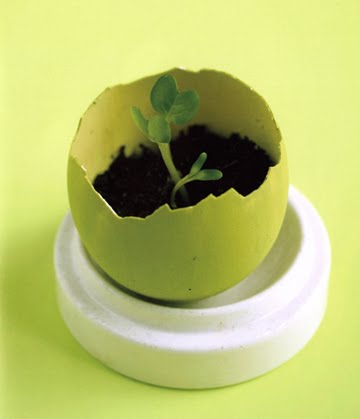 Eggshell seed starters - not only and adorable and affordable way to start your seedlings, but it's also environmentally friendly and really efficient. You see, since you are starting them in eggshells, once they are ready to be transplanted, you can simply put the whole thing in a larger pot or directly in your garden. It reduces the stress of transplanting and also provides calcium to your little plant as it grows and the eggshell decomposes. Not to mention it's a great way to reuse all those carefully coloured eggshell you decorated for easter and may not have thrown out yet.
Why start your seeds inside? If you live in Canada and other northern areas of the globe, you must have noticed how short our summers are compared to the winters. During the winter months, plants stop growing, they are either dead, or dormant. When the temperature increases andt he days are longer, plants can then grow and produce roots, stems, leaves, flowers, fruits, and seeds, this is the growing season. Certain plants need a longer growing season than our climate can offer to ensure a good crop yield. This is where Seed Starting (les semis in french) comes into play. It also allows you to have two harvests of a particular crop.
When I worked for the Youth Garden's at The Montreal Botanical Gardens, we invited the kids to come on certain Saturdays at the end of March and beginning of April to help us start the tomatoes, beetroots, various herbs, green onions, leeks, peppers, and lettuce. Later on, they would plant these vegetables in their gardens, which they tended all summer with the help of their camp counselors and gardening team. This activity has been going on since the late 1930s, it was started by Brother Marie-Victorin, founder of Montreal's Botanical Gardens, as a means to keep city kids in contact with nature. For more information, you can visit the website by clicking here. I must warn you though, it's all in French.
Happy Planting!
Tuesday, January 19, 2010
Zero garbage
I found this amazing blog about a women's 2009 challenge to produce zero garbage. I thought it was amazing and wanted to share. The blog is stocked full of interesting facts, links, and ideas.
Here's the link, go have a look!
http://zerogarbagechallenge.info/
Take care!
Here's the link, go have a look!
http://zerogarbagechallenge.info/
Take care!
Subscribe to:
Posts (Atom)
You might also like
