Tuesday, April 20, 2010

Trivial Tuesdays

Click here to read last weeks Trivial Tuesday Question.


Q. 2
What planet has the longest day?
...


...

A.2 
Venus

Venus is the second planet nearest to the sun. It is sometimes referred to as Earth sister planet because their similar size and gravity. According to Professor Seligman and what I believe to have understood about rotation and day length, Mercury rotates faster and has a longer day length or Synodic Period (~176 Earth days; Venus ~116). So Trivial Pursuit is wrong.

However, it takes Venus -243 days (negative because it rotates in the opposite direction of Earth) to complete a rotation on itself, meanwhile Mercury completes its rotation in ~ 59 days. As a reference, it takes Earth 23 hr 56 min 4.1 sec (it's Synodic Period is 24h). So the error can be understandable. Oh and by these terms,  Wikipedia is also wrong. Have I revolutionized the web? Maybe you guys should read my sources and see what you can make out of this astronomical gibberish. (Click here)
 
In conclusion, I like plants and things that live on the planet because they are easier to understand. As a bonus, here is an easier question.


Q.3 
Where will you find the 20 moons that grace the human body?
...
...

A.2
The base of the nail

Are you impressed I managed to stick with a planetary (or in this case satellite) themed question? I have no merit, I randomly pulled it out of the box.

The moon or lunula, is the whitish arc at the base of your finger and toe nails. It is part of the nail matrix - where the nail is produced.

We generally have ten fingers, ten toes hence the 20 moons.  

If you can't see them, no worries, the lunula is actually located under the nail and not everyone can see it through their nail. 

Now wasn't that simpler?


I'll leave you with next week's question: What sense is most closely linked to memory?

Please, take a guess!
Take care!


Monday, April 19, 2010

April 22nd 2010 - Earth Day

Just a little reminder for all those, like myself, that have a hard time with dates. This upcoming Thursday (April 22nd) is  EARTH DAY!

I thought I would spread the love by sharing some of my favorite Earth Day pictures I found on the web. (You can find the original source by clicking on the picture.) If you want more information, visit EarthDay.org.


Remember, April 22nd!

Take Care!

Friday, April 16, 2010

Random Fact:

Picture by Cyril Ruoso


 Kangaroo babies are called joeys.

Although a fascinating fact, I was expecting something better from a candy wrapper fortune. Then again, it was printed on the inside of a candy wrapper. Sigh. 


Have a Great Weekend!

Take care! 

 [picture credit: Animal Planet]

Thursday, April 15, 2010

Of Red Maples and Magnolias

As promised, here is a short but oh so sweet post about Red Maples and Magnolias in honour of their Spring flowers.

 Red Maple (Acer rubrum)


 A common Eastern North American tree recognized by its characteristic red flowers, petioles, twigs, and seeds.  Its widespread distribution is possible thanks to the Red Maple's adaptability. It grows just as well in poorly drained to very dry soils. Its attractive red fall foliage led to the Red Maple being a popular choice for landscaping projects - which also helped it spread across the continent.

It is possible to make maple syrup from its sap but to a lesser extent than the Sugar Maple (Acer Saccarhum). AND, FYI, it is the state tree of Rhode Island. Now for some pictures.

The next species has very different flowers. Compared to the Red Maple (and most other trees), they are very showy. I think they look like tissue paper, in a good way.


The Magnolia (Magnolia sp.)
Family : Magnoliaceae

Unfortunately, I forgot to get the species name today so I'll get it for you tomorrow. I'll just give you some  general information about the genus. 

The genus Magnolia contains 210 species varying in size, colour, and shape. They were named in honour of French Botanist Pierre Magnol. He is known for inventing of the concept of plant families, a natural classification, based on combinations of morphological characters in 1689 (this is before Linnaeus came up with the binomial classification we use today). 

It is a very old genus, its flowers show the distinctive primitive characteristic of undifferentiated petals and sepals. 
Magnolia flowers are adapted to pollination by beetles. This can be seen in their tough carpels (reproductive parts, stigma and stamens) which reduce damage from crawling and eating insects. 

I really like Magnolia flowers. I love the contrast of the huge flowers and naked branches. Here are some more pics.

These were particularly hard to photograph because of the wind. I was told we also had a yellow Magnolia. I'll try and find it. I'll also be looking for the Tulip Tree - another absolutely beautiful tree with amazing flowers.

Take care!


Wednesday, April 14, 2010

Springtime in the City : Tulip Watch - week 4

Oh boy oh boy oh boy!
Our patience will soon be paid off and by the looks of it we won't be disappointed.
Just in case you randomly tuned, this is the forth consecutive week that I take pictures of a specific patch of tulips growing in the front gardens of Montreal's Botanical Gardens. I'm basically monitoring their growth. I've also added some manifestations of Spring's arrival in Montreal and you are in for a treat this week! You can see the previous posts by clicking on the following links:

Although it was nice and sunny today, it was terribly windy which made taking pictures just that much harder. I'm no photographer so it took longer than usual, but then again, I also got to take pictures of some new spring players. Before we get there, let's look at our tulips.


They are growing nicely and showing signs of fabulous flowers to come. Besides the obvious upcoming flowers, a pattern of maturation caught my eye. I noticed, that the tulips with the most advance flowers grew near the edge of the patch. This correlates with these areas being the first to be freed of snow, so they got a head start. What was even more interesting is that the number of plants showing signs of imminent flowering varied significantly from patch to patch. To better understand, you need visual support. Here is what the front gardens look like.


For Spring, each garden from the front gate all the way up to the main building are filled to the brim with tulips - many different varieties. Our tulips are located in the garden surrounding the black lamp post you see in the distance on the right. 

So, as I was saying, the gardens have different growth speeds, there is a measurable (or at the very least visible) gradation between the furthest from the main building and the nearest.
The gardens furthest away from the main building are about the size of our tulips last week, the gardens just before ours has considerably less visible flower buds, and the tulips nearest to the building are flowering.


I love how amongst all the pink tulips, there is this random pink edges peach one. I thought it really stood out against the others, that is, until I turned the corner and saw this :


A bright red, floppy petaled tulip. Now that is something different. I was quite entertaining to watch the bright coloured petals flop around in the wind.

With our tulips popping out, I think it's time I tell you more about tulips. I'll save it for next week though as I have still more pictures to share with you today. I'll try and get a hold of the person responsible for the tulips at the gardens and ask loads of questions.

Up next are two trees that produce very different spring flowers.


The Red Maple and the Magnolia.

Seeing as it is getting late, I'll save a more elaborate description of these fabulous trees for tomorrow. I've also saved some pretty pictures for you as well so tune in tomorrow. 

Take care!

Tuesday, April 13, 2010

Trivial Tuesdays

Welcome the first installment of Trivial Tuesdays, a weekly post dedicated to the Science & Nature trivia questions found in the 1981 Trivial Pursuit Genius Edition. Be prepared to be stunned, awed, and geniusified. 
 

 Q.1.
How many queen bees reign in a hive?

...


 ...

A.1.
One

So, did you get it right? Isn't the artwork adorable? I found it on a sibling gift idea store called My goodness duds (click here), the broccoli siblings are too cute for words, but I digress. 

The term queen bee is used to refer to the mated female bees that lays all the eggs in the hive. They have the longest lifespan of all the bees in the hive, ranging from 2-7years compared to the few months of a worker bee.
Queen bees are selected from birth. They are layed in a special egg chambers called queen cups and they are fed royal jelly to promote their growth.
The old queen will begin laying virgin females when the climate is good for swarming (mating) or if she needs to be replaced. Once a virgin queen has emerged from her queen cell, her main objective is to seek out and destroy other virgin queens since they are her direct rivals to the throne. During this period, the old queen is allowed to live and keep on producing worker bees. 
The victorious virgin queen will fly out of the hive and seek out a swarm or "drone congregation" and mate with as many as 15 drones (male bees). She will only mate once in her life. She stores the accumulated sperm in a spermatheca. The virgin queen may go out and mate multiple days until she has stored enough sperm.
The no-longer virgin queen returns to the hive and the old queen must either disappear and form a new hive, duel to the death with the new queen or be killed by the hive. Intruders and old queens are killed by "balling" a.k.a cuddle death. The workers cluster tightly around the victim and cause death by overheating.

Interesting fact, queen bees do not have barbed stingers which means that unlike the worker bees, they can sting as much as they please.


See you next week!
Take care!

Thursday, April 8, 2010

Spring Time in the City : Tulip Watch - week 3

A lot can change in a week and a day.
Last week (click here) our little tulips were about 2 inches high, this week, after a glorious Easter weekend, they have doubled in size. Some tulips planted near the building are even flowering, our tulips are next, you can see the flower bud in the middle. It's coming! Maybe next week we'll discover was colour they'll be. How exciting!

In my last post I mentioned that I would post some pictures of spring flowers I took in Quebec City over the Easter Holidays, so here they are.


I love seeing all these colours after the gray wetness of the end of winter. I haven't identified these species yet, so if you know them, pass on the knowledge.

In other news, next Tuesday will be the beginning of Trivial Tuesdays, a series of posts based on the science questions found within the board game Trivial Pursuit. Should be lots of fun, I'm learning so many random facts of life, I felt compelled to pass them on to you.

Take care!

Tuesday, April 6, 2010

Start your seedlings

Post-Easter greetings to all, I hope you had a wonderful weekend. 
The weather was absolutely glorious in Quebec for Easter and I can't wait to see how our little tulips are doing. I should be posting the pictures on Thursday this week. I've also got some pictures of crocuses and other unidentified spring flowers that I took while visiting my grand-parents in Quebec city. I Can't wait. 

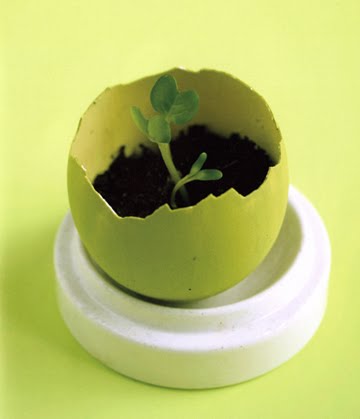
Until then, I wanted to share this wonderful I idea with you. My aunt, a school teacher, told me of this project on Friday and now, one of my all time favorite blog Storage & Glee, has posted the perfect picture. 

  Eggshell seed starters  - not only and adorable and affordable way to start your seedlings, but it's also environmentally friendly and really efficient.  You see, since you are starting them in eggshells, once they are ready to be transplanted, you can simply put the whole thing in a larger pot or directly in your garden. It reduces the stress of transplanting and also provides calcium to your little plant as it grows and the eggshell decomposes. Not to mention it's a great way to reuse all those carefully coloured eggshell you decorated for easter and may not have thrown out yet.
Why start your seeds inside? If you live in Canada and other northern areas of the globe,  you must have noticed how short our summers are compared to the winters. During the winter months, plants stop growing, they are either dead, or dormant. When the temperature increases andt he days are longer, plants can then grow and produce roots, stems, leaves, flowers, fruits, and seeds, this is the growing season. Certain plants need a longer growing season than our climate can offer to ensure a good crop yield. This is where Seed Starting (les semis in french) comes into play. It also allows you to have two harvests of a particular crop. 

When I worked for the Youth Garden's at The Montreal Botanical Gardens, we invited the kids to come on certain Saturdays at the end of March and beginning of April to help us start the tomatoes,  beetroots, various herbs,  green onions, leeks, peppers, and lettuce. Later on, they would plant these vegetables in their gardens, which they tended all summer with the help of their camp counselors and gardening team. This activity has been going on since the late 1930s, it was started by Brother Marie-Victorin, founder of Montreal's Botanical Gardens, as a means to keep city kids in contact with nature. For more information, you can visit the website by clicking here. I must warn you though, it's all in French.

Happy Planting!

Wednesday, March 31, 2010

Spring Time in the City : Tulip Watch - week 2

Hello boys and girls,

Today was a dreary day in Montreal but nevertheless, I took my hands out of my warm pockets and froze my little fingers to bring you news from the tulip patch. You can click here to check out last week pictures.

Our little beauties are growing peacefully through the bout of cold weather we are receiving this week, nothing is going to stop them from blooming this year, except maybe those pesky squirrels. I'll be showing you proof that squirrels are absolutely nuts, or at least this one squirrel is. I just have to figure out how to post a video onto You Tube and then place a link onto my blog.

Well, onto the pictures.


There is not much difference to be seen by the untrained eye but if you look closer, you'll notice that most tulips now have three visible leaves and are a little taller. I'll try and put a height reference in future pictures and I've found a physical reference point to take a picture of the same individuals next time. You see, I'm improving all the time.

I just love how the leaves are holding on to the water in the last picture. This is also a great shot to realize that new leaves come from the inside and they wrap around each other, this are referred to as sheathing leaves.

I found this amazing picture of pink/purple tulip leaves, check it out by clicking here.

How are the tulips near your place? Send me some pictures and I'll post them along side mine next week. You can send your .jpeg files to emiliedwolf{at}gmail{dot}com. I can't wait to see them!

Take care!
Reblog this post [with Zemanta] 

Monday, March 29, 2010

To Save Water, Eat Less Beef and Chocolate

Fresh water availabilty has and will always be a source of concern for environmentalist and let's face it, every single living thing out there; without water there is no life as we know it. Oh sure, 71% of the Earth is covered with water but most of it is salt water which we cannot really use and I have yet to hear about an effective (inexpensive and large scale) way to transform salt water into fresh water, so we are stuck with what we have. Year after year we are presented with Water Conservation campaigns; we know the drill, take short showers, turn the faucet off when you brush your teeth, use low flow shower heads, faucets, and toilets, etc., but that is just household usage, what about the water that is used to answer all our needs?

Nation Geographic has built this brilliant web resource (for lack of a better word to call it) illustrating the amount of water necessary for the production of various goods. You can compare between meat and grain options, learn the impact of your chocolat indulgence, or just realize just how important water is. Click here to find out more.

I was astonished to find out that to produce one pound of beef, you needed 6810 liters of water (1799 gallons) and horrified to know that one pound of chocolate required 12000 liters (3170 gallons)! On average, americans  use 168L per day, does this estimate include my emergency chocolate bar? Since I don't eat beef, can I forgive my chocolate cravings? What a dilema.

If you are concerned about water usage and availability or are just curious by nature, you can find a free downloadable copy of the National Geographic's Special Issue on Water by clicking here. Check it out fast, it's only free until April 2nd.


Take care!

Friday, March 26, 2010

Spring Time in the City : Montreal 2010

WITCH-HAZEL FLOWERS & TULIPS SPRINGING FORTH

I love seeing signs of spring: birds flocking in overhead, soft green buds on tree branches, little green leaves popping out of the ground, and flowers, oh how I love seeing spring flowers.

Spring came earlier this year in Montreal, especially in the Botanical Garden's little sheltered courtyard. Employees from all over have been passing by the office to get a glimps and a snif of the vibrant and wonderfully odorant Witch-Hazel flowers.

Wikipedia just informed me that Witch-Hazel branches were once used as divining rods to find ground water. The name just reminds me of the bottle of astringent liquid used to tighten up your pores, reducing the appearance of blackheads - not quite as exciting. However, it is still a valid associationg since Witch Hazel liquid is produced from the leaves and the bark of the North-American variety (Hamamelis virginiana).

First used by Native Americans to treat cuts, insect bites, and other inflammations; it's now widely used all over the world. Apparently, you can also use it instead of hair-spray when curling your hair - amazing what you can learn on the internet is it not?

What I really like about this plant, apart from the wonderful smell, is the look of its flowers. They appear before the new leaves, each part comes in groups of four; 4 red cup-shaped sepals, 4 half an inch long, very slim or strap-shaped, yellow petals, 4 red stamens, and a double stigma.


How wonderful. Anyway, this plant is also called Winterbloom because of its early blooms. They make me terribly happy. Another thing that brings joy to my heart are little tulips sprouting out from the still snow covered ground. The Botanical Garden has an intensive tulip display as you walk in the main gate. I noticed the first leaves this week so I took a picture to share with you guys - for once I had my camera and found a subject that doesn't run off before I can snap a picture.
I tell you more about tulips once we can see more of their characteristics. I'll try and post pictures of their development every week, we can watch them grow together.


You can see the main building of the Botanical Garden looming in the background, that's where I work...I think I might have never mentionned that... I must tell you all about my exciting job, but that will be for another time darlings for I am simply exhausted. Until then, keep your eyes open for signs of the coming spring - they are all around you just waiting to be noticed.

Take care!

Tuesday, March 23, 2010

Book Review : Never Cry Wolf by Farley Mowat

Never Cry Wolf
Never Cry Wolf
by Farley Mowat

Written in the 60s by a Biologist about the year he spent up in Northern Canada studying wolves for the Canadian government, this book is filled with interesting facts and fascinating anecdotes.

The book is well written and is an enjoyable read. A wonderful blend of science and humour. The vocabulary is well researched and in many cases quite advanced. I must admit I learnt more than a couple words over the course of the 176 pages.

Mowat begins his book by explaining what brought him to the Canadian Wildlife Agency in the first place - his love for all things living. After his studies, he chose the path less beaten of field biology and was sent up North to study the Wolf population. At the time, hunters were complaining to the Agency that wolves were the cause behind the reduction the caribou herds. Hunting being a very lucrative pass-time for the state, the government were looking for results and Mowat was the man to bring them. So off he went with half a canoe, a tent, a sleeping bag, and seven axes as part the the official field kit. He flew from Ottawa to Churchill in a military plane and from there was left to find his way to a remote area with a high density of wolves, to set up his base camp. And that was that.
Luckily for him his plane dropped him not too far from a hunting shack belonging to a young inuit hunter and his sleigh dogs. From there, he set out to find some wolves. This was no easy task for although the State's population estimate at the time was one wolf for every two square miles, they remained elusive for quite some time before Mowat caught a glimps of a large male.
He tracked the male to its den and once found, he set up his observation post near by. For many months, he watched, taking accurate and fascinating notes on family behaviour, eating habits, and general ecology of the species.
Throughout his stay, he had to adapt to the ways of the wild, meanwhile performing rigorous science and looking for proof of the link between the declining caribou herds and wolf populations, to support the extensive wolf kull endorsed by both the Provincial and Federal Governement. Although he never truely states it, there is no such proof from the wolves but the list is long on the side of the humans.

This book teaches you not only about wolves, but also about life in Northen Canada, local native cultures, plants and animals of the region, the difficulties of doing research is such remote areas, and the wonderful incompetance of government officials. One of my favorite anecdotes in this book illustrates the later very well. It appears near the beginning of the book and sets the tone for the rest. Shortly after arriving in Churchill, a storm hits and Mowat is stuck in the little town unable to continue onto the research area and the wolves. At this time he telegrams the head office in Ottawa to tell of his misfortunes and ask for further instructions. Not only do they not understand, they remind him that he has a deadline to respect and that they are expecting a first report shortly. With no sign of a pilot and the weather remaining as it was, he turned to what was available in town: ''missionairies, prostitues, mounted policemen, rum-runners, trappers, fur smugglers, ordinary fur traders and other interesting characters'', all of whom became his wolf authorities for his first report. A report that went on to become ''the final word on Canis lupus'' in Ottawa.

A brilliant book, a fascinating story, and a truthful yet depressing look on how the Canadian government managed our wildlife. I strongly recommend.

For those less inclined to read, this book has been made into a movie.

Take care!

Saturday, March 20, 2010

What's for supper : Primavera Pesto Pasta

Yes, I am aware that making food has absolutely nothing to do with nature or the environment but I simply have to tell you about this recipe I found in Kraft's What's Cooking magazine (also available online here).
It's easy to make, requires very little ingredients, and tastes FANTASTIC.

I modified the recipe a little so this is how I did it and it served 5 people.

Ingredients:
Fettuccine
Philadelphia Cheese (about 250g)
Asparagus (5-6)
Olive oil
Garlic
Pesto (4-5 tbs)
Green Onions (3-4) 
Vegetable broth (1/2 cup)

How to:
Boil your fettuccine and add the chopped asparagus for the last couple of minutes.
In a skillet fry up some garlic in a little olive oil before mixing in the Philadelphia cheese, pesto, vegetable broth, and green onions. Let simmer for 3-4 minutes.
Mix the creamy sauce with the drained fettuccine and asparagus. VOILĂ€! You have a wonderful meal ready to serve.

I figure to justify this receipe on my nature blog, I'll tell you about asparagus.

Let's start by defining vegetable. The term refers to any part of a plant that is grown for consumption. A carrot is a root, a tomato is a fruit, and what we refer to as asparagus is the young steam (shoot) of the asparagus plant.

It has been classified into the Liliaceae family but I have also found it classified in its own family: Asparagaceae. I'll get back to you on this. Other vegetables in the Liliacea family include garlic, onions, and leek.

If left to grow, it would become this tall wispy fern-like herbaceous plant with tiny little white or yellow flowers. It's cultivation is a little different from other vegetables. It's perennial because of it's rhizome (underground stem) which produces shoots. The earliest shoots are the best harvest but depending on your growing season, you can have multiple harvests in the same year.  A Quebec producer, Mr. Phil Quinn, told me that he waited 1-2 harvest seasons before harvesting his first crop to let the asparagus produce nice thick rhizomes and healthy shoots. Once deamed ready, he harvests twice before letting them grow out and produce seeds.  Once they've grown to over a foot in height they don't taste as good so eventhough they are still edible, they are not marketable.
Happy cooking!
Take care!

[Picture credits Kraftcanada.com; Kitchenproject.com]

Tuesday, March 16, 2010

Octopuses and HDTV

I stand corrected, the plural form of octopus is not, as I have lovingly believed, octopi but octopuses -which sounds so much less impressive. It has something to do with the word octopus coming from the greek instead of the latin.

Anyway, I found this great little article posted on Observations of a Nerd about scientists that managed to fool octopuses into responding to a video played in HD. The story goes that octopuses do not respond to video stimuli which complicated the study of interactive behaviour, that is until HD came along. Scientists can now observe behaviours towards selected videos. Please read on by clicking here.

She posted a little video to go along with her well written post. I stole it and placed it here for our enjoyement.


Long live Cephalopods!

Take care!

You might also like

Related Posts with Thumbnails